
The Lost Fables of Appalachia
The Buck Moon
I am the author and illustrator of The Lost Fables of Appalachia, a children’s book series inspired by Appalachian wildlife, landscapes, folklore, and the art of storytelling. My newest book in the series, The Buck Moon, follows an naive young buck named Roscoe on one unforgettable night in the Appalachian forest.
Roscoe has grown up hearing the legend of the Buck Moon—a tale that says the deer who can pull the moon from the sky will become King of the Forest.
And Roscoe is determined to do exactly that.
His plans soon cross paths with Earl, a grumpy old horned owl whose peaceful days have recently been disturbed by some very noisy new neighbors. What follows is a little bit of mischief, a little bit of magic, and a night the forest will not soon forget.
The artwork featured here includes illustrations created for The Buck Moon, bringing Roscoe, Earl, and their Appalachian forest home to life.
The Series
The Lost Fables of Appalachia is a collection of original stories straight from the forests of these ancient mountains—where clever foxes, curious creatures, and a little Appalachian mischief are never far away.
Book One: The Tale of Jeter Gray Fox
Book Two: The Buck Moon
Coming Soon: The Journey of Basil Red Fox
Written and illustrated by Appalachian artist and storyteller Kat von Hacke.
Read The Tale of Jeter Gray Fox at Your Library!
Check It Out!
Want to spend a little more time with Jeter Gray Fox? The Tale of Jeter Gray Fox is available through the Hall County Library System!
Look for it in the library catalog and check out a copy to continue the story at home.


Roscoe's very bad night
Looking Deeper
The idea for The Buck Moon came to me last summer. As the real Buck Moon approached, I imagined an old forest legend: somewhere in the Appalachian mountains, it was said that a buck capable of pulling the moon from the sky would become King of the Forest.
I loved the image of a great, mythical buck carrying the moon through the trees—and, of course, the idea of an overly ambitious young deer named Roscoe deciding that he could do it too.
At the time, I was busy illustrating the first book in The Lost Fables of Appalachia, so I quickly wrote down Roscoe's story and tucked it away for later. Months later, during my winter artist residency in West Virginia, I returned to The Buck Moon and began bringing Roscoe's adventure to life, with plans to release the finished book the following summer beneath another Buck Moon.
On This Page
This illustration captures one of my favorite moments in the book. Roscoe, convinced he has finally found the Buck Moon, discovers that the glowing "moon" tangled in his antlers is actually a hornets' nest. As a swarm of very unhappy hornets gives chase, he races through the forest, startling every sleeping creature in his path. Owls peer from the trees, curious woodland animals awaken, and a bewildered audience watches a young buck sprint by with a hornets' nest perched proudly on his antlers. A sinister looking Jeter Gray Fox can be seen perched in a tree.
Like many Appalachian stories, The Buck Moon is filled with humor, heart, and just a little bit of chaos.
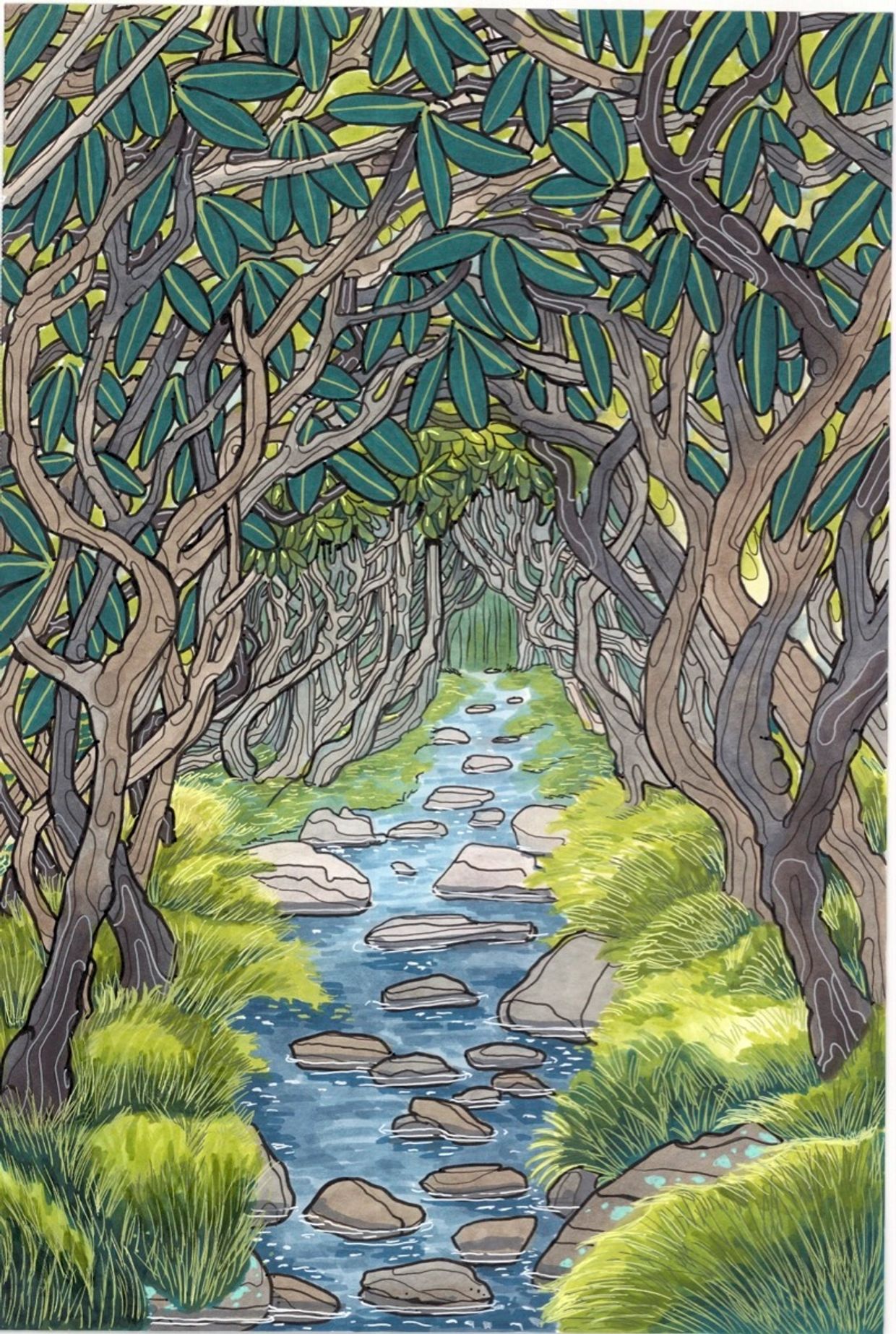
mountain stream
Looking Deeper
The Buck Moon begins on a bright summer day in the Appalachian forest. As Roscoe's adventure unfolds, however, something subtle begins to happen—the illustrations grow progressively darker.
With each turn of the page, afternoon gives way to evening and eventually night, while Roscoe's grand plan manages to go increasingly wrong. The darkest moments in the story coincide with some of Roscoe's greatest predicaments.
This mountain stream appears at the very beginning, when the forest is still warm, sunny, and peaceful. For now, everything is perfectly delightful.
Roscoe hasn't caused any trouble yet.
On This Page
This illustration was inspired by a delightful little stream I encountered in Joyce Kilmer Memorial Forest, but it captures a scene familiar throughout the Appalachian Mountains—clear mountain water cheerfully babbling over river stones beneath a twisting tunnel of rhododendron.
Much of my work begins with places I have explored myself. I may start with a particular stream, trail, forest, or mountain, then allow it to become part of the world of The Lost Fables of Appalachia.
My illustrations are created traditionally by hand using alcohol markers, ink, and gel pens. I especially love using layers of line, color, and tiny details to capture the wonderfully tangled, wild character of an Appalachian forest.
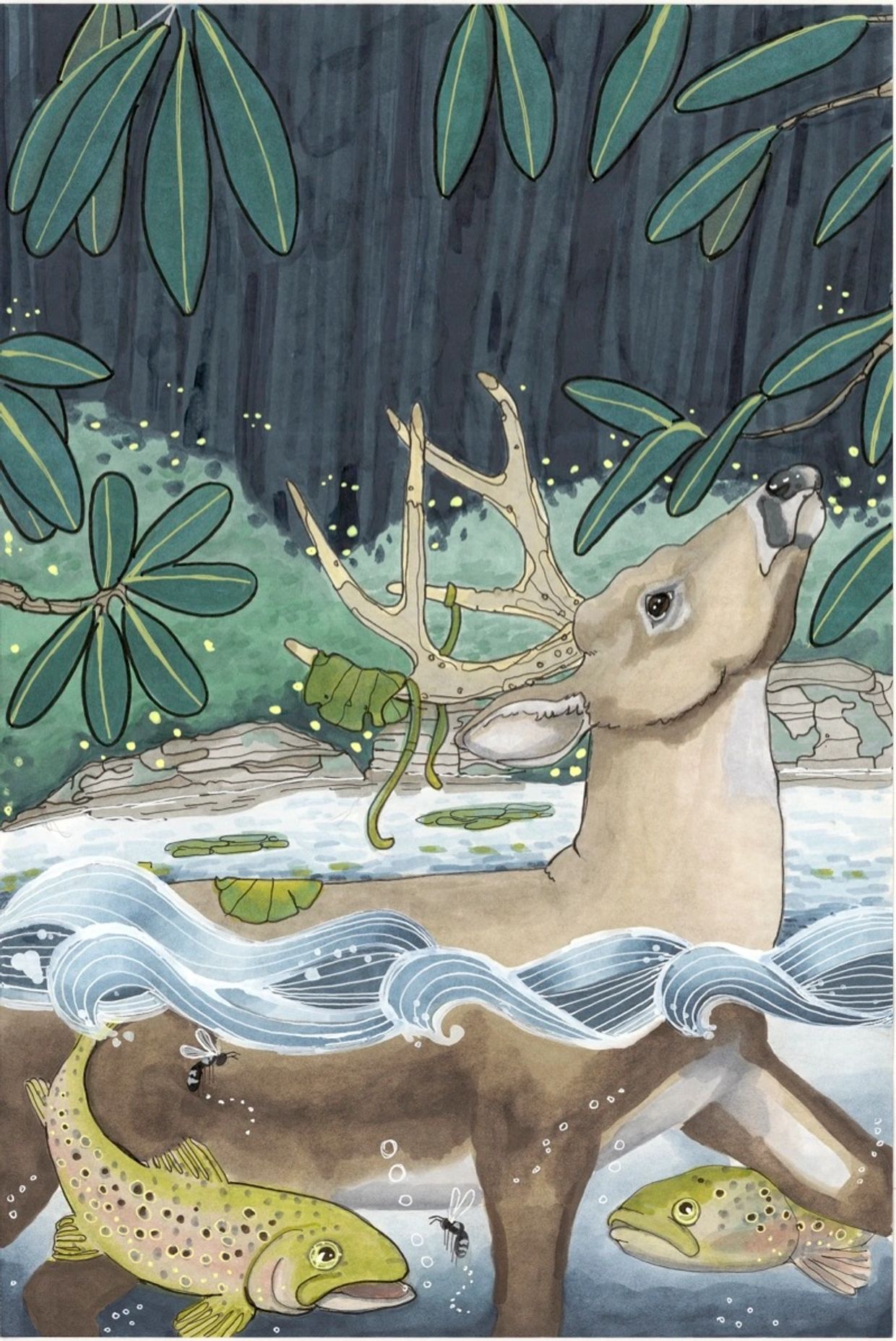
Roscoe in the pond
Looking Deeper
After racing through the forest with a swarm of angry hornets close behind, Roscoe finally plunges into a mountain pond.
He emerges soaked, covered in lily pads and pond scum, stung, exhausted—and thoroughly humbled. By now, Roscoe's disastrous attempt to become King of the Forest has awakened nearly every creature around him, and the whole forest is laughing.
Even the trout.
This illustration captures the finale of Roscoe's very bad night: the moment when his grand adventure finally comes to an end and our overly ambitious young buck learns that perhaps some forest legends are better left alone.
On This Page
This is one of the darkest illustrations in The Buck Moon, both literally and within Roscoe's story. The bright, sunny forest from the beginning of the book has disappeared completely. We have followed Roscoe from daylight into the deep blues and greens of an Appalachian night.
But even in the darkness, the forest is full of life. Fireflies glow beneath the rhododendron, insects hover over the water, trout swim below the surface, and Roscoe stands right in the middle of it all—wet, miserable, and wearing pieces of the pond in his antlers.
I especially love filling my illustrations with small details and moments of humor for readers to discover. In this one, be sure to look beneath the water.
Even the trout are laughing at Roscoe.